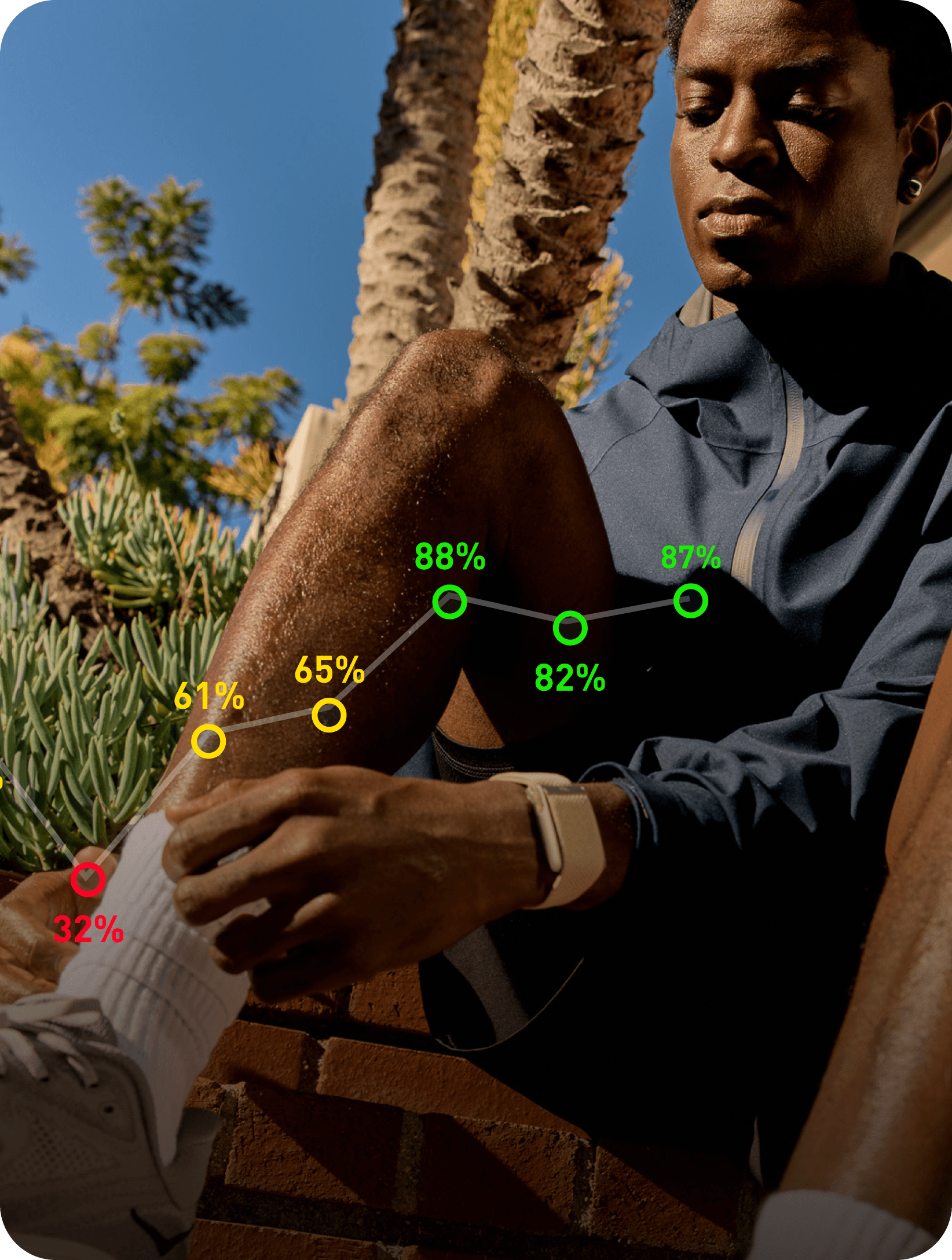
Readiness Score: WHOOP, Garmin, Oura, and Apple All Have the Same Problem
Recovery and readiness scores from popular wearables lack solid scientific evidence. What does that mean for users who rely on them?
Every morning I glance at my wrist and WHOOP tells me how I'm doing. Green — go for it. Red — rest. But what if that number I'm building my entire training day around doesn't have the solid scientific foundation I'd like it to?
Last week, Gadgets & Wearables laid out an uncomfortable truth: readiness and recovery scores from WHOOP, Garmin, Oura, and Apple rest on surprisingly thin evidence. And it applies to all of them.
What Does Readiness Score Actually Measure?
Each company does it slightly differently, but the principle is similar. They take raw data — heart rate variability (HRV), resting heart rate (RHR), sleep quality, skin temperature — and run it through an algorithm to spit out a single number. For WHOOP, that's a recovery score on a 0–100% scale. Garmin calls it Body Battery and Training Readiness. Oura has Readiness Score. Apple introduced Vitals.
The appeal is obvious: instead of interpreting five different metrics, you get one answer. Am I ready or not?
Where's the Problem?
The problem isn't the sensors themselves. Optical heart rate measurement on your wrist has its limits, but it's gotten significantly better over the years. The issue is one level up — how raw data gets turned into that final score.
Gadgets & Wearables flagged several concerns:
- Proprietary algorithms. None of these companies fully disclose exactly how they calculate recovery or readiness. WHOOP describes the inputs (HRV, RHR, sleep, respiratory rate), but keeps the weighting and logic under wraps.
- Few independent validation studies. A 2024 systematic review in the Journal of Sports Sciences found that evidence for the validity of wearable recovery metrics is limited and methodologically inconsistent. Most existing studies have small sample sizes or are funded by the manufacturers themselves.
- No gold standard. Unlike VO2max, where a lab test serves as the reference, there's no objective gold standard for "readiness." How do you verify you're actually at 73% and not 68%?
This isn't just a WHOOP problem. Garmin, Oura, and Apple are in the exact same boat. None of them have robust, independently replicated evidence that their specific score reliably predicts performance or injury risk.
So Should I Throw It All Out?
No. But you need to separate two things.
Raw data has value. When my HRV drops 20 ms below my 30-day average and my resting heart rate spikes 5 beats, something's happening. Maybe I overdid the alcohol yesterday, slept poorly, or a virus is starting. That's a physiological signal that makes sense and has scientific backing.
Composite scores are an interpretation layer. And they can be useful as a quick reference point, but I shouldn't treat them like a medical verdict. When WHOOP shows 38% recovery, it doesn't mean I have to stay in bed. It means: dig into the details, think about it, listen to your body.
After two years with WHOOP, I see it this way: the recovery score helps me notice trends I'd otherwise ignore. But I've learned not to panic when it's yellow once in a while, even though I feel fine.
What This Means as a User
A few practical takeaways:
- Watch trends, not individual days. One morning number is noise. A weekly average is signal.
- Look at the raw data. WHOOP is fair about this — HRV, RHR, and sleep stages are all accessible in the app. Learn to read them.
- Don't stop listening to your body. A wearable is a supplement, not a replacement for how you actually feel. If you feel great and WHOOP says red, try an easier workout and see what happens.
- Don't expect medical precision. None of these devices are certified medical instruments for diagnosis. And that's worth saying out loud.
Did This Change How I View WHOOP?
Honestly — not fundamentally. I've never thought of WHOOP as a scientific instrument. It's a tool that forces me to look at sleep and training load systematically. And that's where its real value lies.
But I'm glad the evidence gap is being discussed openly. It pushes manufacturers to invest in independent research. WHOOP actually hired a chief medical officer recently — maybe we'll get stronger data.
Readiness and recovery scores from all the major brands rely on similar inputs and similarly weak evidence. That doesn't mean they're useless — but it's good to know what you're buying. A compass, not GPS with centimeter accuracy.
Until then: wear your WHOOP, track the trends, but remember to look up from the screen once in a while and ask yourself how you actually feel.
Want a WHOOP too?
Through my link you get the WHOOP hardware free + the first month of membership free. WHOOP rewards me with one month back. Win-win, costs you nothing extra.
Get WHOOP free →